

Veneers vs Invisalign for Crooked or Gapped Teeth: Which Should You Choose?

Veneers can make crooked or gapped teeth look straight in a week. Aligners actually move them. Here's when each is the right call, what each costs, and when the honest answer is to do both, in that order.
"Can veneers fix my crooked teeth?" is one of the most common questions in our WhatsApp inbox. The short answer is yes, sometimes. The longer answer is that veneers and clear aligners such as Invisalign do two fundamentally different things, and choosing the wrong one is how people end up with veneers that look bulky, teeth that were cut down more than they needed to be, or a year of aligner trays that never fixed the thing they actually disliked.
We place veneers for a living, so we have a side here. That is exactly why this guide spends as much time on when not to choose veneers as on when to choose them.
Quick answer: clear aligners move your teeth; veneers change how your teeth look. If your teeth are only mildly rotated or slightly gapped, and you also dislike their colour, shape or chips, veneers can give you a straight-looking smile in about a week with little enamel removed. If your teeth are moderately to severely crowded, if your bite is off, or if your teeth are otherwise healthy and you like their colour, aligners are the better choice, because forcing a straight look with veneers on crooked teeth means cutting more enamel than is safe. For many people the best answer is both: a short aligner course first to put the teeth in a better position, then fewer, thinner veneers.
What each treatment actually does
Clear aligners (Invisalign is the best-known brand) are a series of removable plastic trays, each slightly different from the last. Worn 20 to 22 hours a day, they move teeth gradually through the bone. The result is your own teeth, in a new position, with the same colour and shape they had before. Mild cases often take around 6 to 12 months, more complex ones longer, and you need a retainer afterwards, usually at night, indefinitely, or the teeth drift back.
Veneers are thin shells of porcelain or composite resin bonded to the front of the teeth. They do not move anything. They change the visible outline of each tooth, so a tooth that sits slightly back can be built forward, a rotated edge can be squared off, and a gap can be closed by making the neighbouring teeth a little wider. Because they also change colour and shape, the whole smile is redesigned at once. Porcelain usually takes one trip of about five days; composite can be done in a couple of visits.
That difference, moving versus masking, decides almost everything else.
Side-by-side comparison
| Clear aligners (e.g. Invisalign) | Porcelain veneers | Composite veneers / bonding | |
|---|---|---|---|
| What it changes | Tooth position and bite | Colour, shape, length, apparent alignment | Colour, shape, small gaps and edges |
| Fixes the bite? | Yes, within limits | No | No |
| Changes colour? | No (whitening is separate) | Yes | Yes |
| Treatment time | Often 6 to 12+ months | About 5 days, one trip | 1 to 3 days |
| Enamel removed | None | Usually 0.3 to 0.5 mm; more if masking crowding | 0 to 0.2 mm |
| Reversible? | Yes | No | Mostly |
| Lifespan | Permanent if you wear retainers | 15 to 20+ years | 5 to 8 years |
| Ongoing commitment | Nightly retainer, long term | Night guard if you grind; regular check-ups | Polishing and touch-ups |
| Typical price | Commonly $3,000 to $8,000 in the US | $275 per tooth in Colombia | $119 per tooth in Colombia |
| Visits needed | Check-ins every several weeks for months | One trip | One short trip |
US porcelain veneers commonly run $1,200 to $2,500 per tooth. Our full per-treatment pricing is in the smile makeover cost guide.
When veneers are the right call
Veneers make sense for crooked or gapped teeth when the misalignment is the smaller part of the problem:
- Mild rotation or a tooth that sits slightly back. If a lateral incisor is a millimetre behind its neighbours, a veneer can be built a little thicker to bring its face forward without removing much enamel.
- Small gaps. Spaces of roughly 1 to 2 mm, including a gap between the two front teeth, can usually be closed by widening the teeth on either side. Larger gaps can be closed too, but the teeth start to look too wide, and that is a judgement we make on a smile design, not by eye.
- Teeth you would want to change anyway. If you also dislike the colour, worn edges, chips, uneven lengths or old fillings, veneers solve the alignment and those problems at the same time. That combination is where veneers are clearly the better value.
- Adults who will not wear aligners consistently. Aligners only work if they are in your mouth 20+ hours a day. Some people know honestly that they will not manage a year of that.
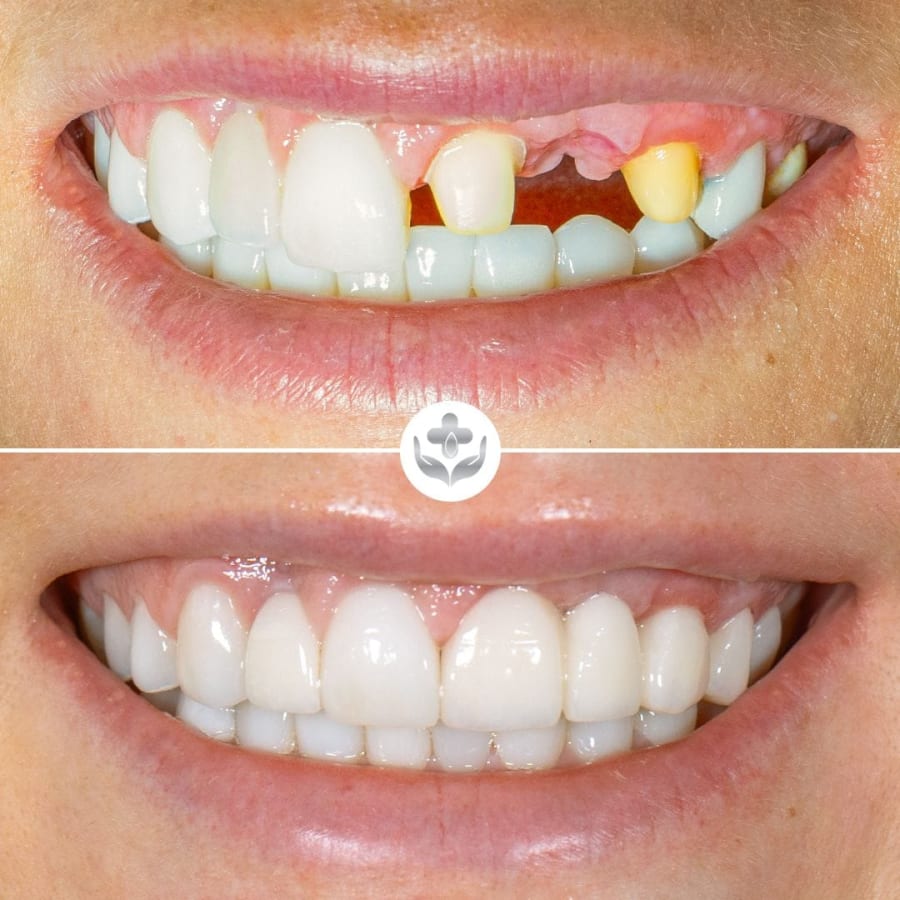
The hero image of this post is a good example: the upper teeth were slightly uneven and discoloured and worn. Straightening them first would have left the colour and shape problems untouched.
When aligners are the right call
This is the list we go through when someone asks for veneers and we say no, or not yet:
- Moderate or severe crowding. To make overlapping teeth look straight with veneers, the dentist has to cut the teeth that stick out back into line. That often means going through enamel into dentine, which bonds poorly and can lead to sensitivity or a root canal years later. Our guide on whether veneers ruin your teeth explains why over-preparation is the real risk, not the veneer itself.
- Bite problems. Deep overbite, underbite, crossbite or an open bite are about how the jaws and teeth meet. Veneers cannot fix them, and veneers placed on a bad bite are more likely to chip or debond.
- Healthy teeth you like the look of. If your only complaint is position, and your teeth are a good colour and shape, there is no reason to cover them. Aligners keep 100 percent of your enamel.
- Teenagers and young adults. We do not veneer healthy teeth on very young patients for alignment alone. Orthodontics is reversible; veneers are a lifelong commitment.
One practical point for anyone travelling for treatment: aligners are not a travel treatment. They need a clinician to check progress every several weeks over many months, adjust the plan and fit attachments. That is a case where we usually point people to an orthodontist close to home.
Matching your situation to a treatment
| Your situation | What usually works best | Why |
|---|---|---|
| Slight rotation or one tooth a little behind; also unhappy with colour or shape | Porcelain veneers | Fixes the look and the alignment in one trip with conservative prep |
| Gap between the front teeth, under about 2 mm, otherwise happy | Composite bonding | Little or no enamel removed, low cost, reversible |
| Several small gaps across the smile plus discolouration | Porcelain or composite veneers | Gaps and colour solved together |
| Noticeably overlapping or crowded teeth | Aligners first, then reassess | Masking crowding with veneers needs aggressive prep |
| Overbite, underbite, crossbite | Orthodontics | Veneers cannot change the bite |
| Crowding plus worn, chipped or dark teeth | Aligners first, then veneers | Fewer, thinner veneers on teeth that are already in line |
| Straight but small, worn or discoloured teeth | Veneers | Nothing to move; the issue is shape and colour |
The "both" option: aligners first, veneers second
For a meaningful share of people with crooked teeth and cosmetic complaints, the best plan is sequential. A few months of aligners puts the teeth in a better position, and then veneers finish the look.
It sounds slower and more expensive, but it often isn't, for three reasons:
- Less enamel removed. On teeth that are already in line, veneers can be thinner, sometimes minimal-prep.
- Fewer veneers. Once the arch is aligned, the teeth that only needed moving may not need covering. Our guide to how many veneers you need explains how that count is worked out.
- Longer-lasting veneers. Veneers bonded mostly to enamel, on a stable bite, simply last longer.
In practice that usually means an aligner phase with a local orthodontist, then a single trip to Medellín for the veneers once the teeth are settled and the retainer is in place. We are happy to review your photos at the start, so the orthodontic goal is set with the veneers in mind.
What it costs over 15 years, roughly
People often compare the sticker prices and stop there. A fairer comparison looks at what you are paying for over time:
- Aligners: one fee, usually a few thousand dollars in the US, plus replacement retainers every few years. Your teeth stay your own, and you can still whiten them in the chair later.
- Porcelain veneers: $275 per tooth here, so around $2,000 to $2,500 for 8 to 10 upper teeth before the trip, and the set should last 15 to 20+ years with good care. At some point they will need replacing, and those teeth will always need a restoration.
- Composite: $119 per tooth, the cheapest entry point, but expect polishing and replacement within 5 to 8 years.
None of these is "cheaper" in the abstract. The right one is the one that fixes your actual problem with the least irreversible change. Our porcelain vs composite guide covers the material choice if you land on veneers.
Questions to ask before anyone veneers crooked teeth
Wherever you are treated, these questions separate a conservative plan from a shortcut:
- How much enamel will you remove on each tooth, and why that much? It should differ tooth by tooth on a crowded arch, and the teeth that stick out should be the concern.
- Did you consider orthodontics first? A good cosmetic dentist will have an opinion, not a shrug.
- Can I see the result as a mock-up before you prepare anything? A digital smile design or a trial smile shows whether the teeth will look natural or bulky.
- Is my bite involved? If nobody looked at how your teeth meet, nobody has assessed the risk of chipping.
- Are these veneers or crowns? Masking severe crowding sometimes quietly turns into crowns. Ask.
So which should you choose?
- Mild misalignment plus colour or shape complaints: veneers, usually in a single trip.
- A small gap and nothing else: composite bonding.
- Crowding, bite problems or healthy teeth you like: aligners.
- Crowding plus cosmetic complaints: aligners first, veneers second.
If you are not sure which group you are in, that is normal. It is very hard to judge from a mirror, and it is exactly what we look at in a photo review. The full process, materials and pricing are on our veneers in Medellín page.
Next step
Send a photo, get an honest answer
Message us a smiling photo and one with your teeth together. We will tell you whether veneers, bonding, aligners or a combination makes sense for your teeth, how many teeth would be involved and what it would cost. Free, and if the right answer is "see an orthodontist first," we will say so.
Ask About My TeethSee exactly what a trip includes on the veneers package page. En español: carillas dentales y carillas de resina.
More from our blog.
Full-Mouth Reconstruction: What It Involves, Who Needs It & How It's Sequenced
Full-mouth reconstruction rebuilds the bite as well as the smile: crowns, implants, root canals and veneers planned together. What it involves, who actually needs it, the order the work is done in, what it costs in Colombia, and when a full-arch bridge is the better answer.

Veneer Chipped or Fell Off After You Flew Home? What to Do First
A veneer that pops off or chips after a dental trip abroad is rarely an emergency. What to do in the first 24 hours, whether a local dentist can re-bond it, what the warranty covers, and how to stop it happening again.

Zirconia vs E.max Crowns: Strength, Looks, Cost & Which Teeth Need Which
Zirconia (ZirCAD Prime) is the stronger crown, e.max (lithium disilicate) is the more lifelike one. How they compare on strength, looks, tooth preparation and price, which teeth usually get which, and when neither is the right answer.