

How Many Veneers Do You Actually Need? 6, 8, 10, or a Full Set

How to figure out how many veneers you need for a natural result — your smile line, how many teeth show when you smile, and why 8 and 10 are the most common numbers. With a 2026 cost breakdown for Colombia.
It's the question almost every patient asks once they've decided they want veneers: "OK — how many do I actually need?" The honest answer is that it depends on your smile, not on a fixed rule. But there's a clear way to figure it out, and in practice most people land on one of just a few numbers.
This is the exact reasoning we walk every patient through during their virtual consult.
The short version
- Most people need 8 veneers — the teeth that show when you smile naturally.
- Some need 10 — if your smile is wider and shows more teeth.
- A few need 6 — if your smile line is narrower, or budget is the priority.
- A full set (16–20) is rare and usually only for full-mouth reconstruction, not cosmetics.
The number is driven by one thing above all: how many teeth are visible when you smile and talk. You don't put veneers on teeth nobody ever sees.
The one factor that decides it: your smile line
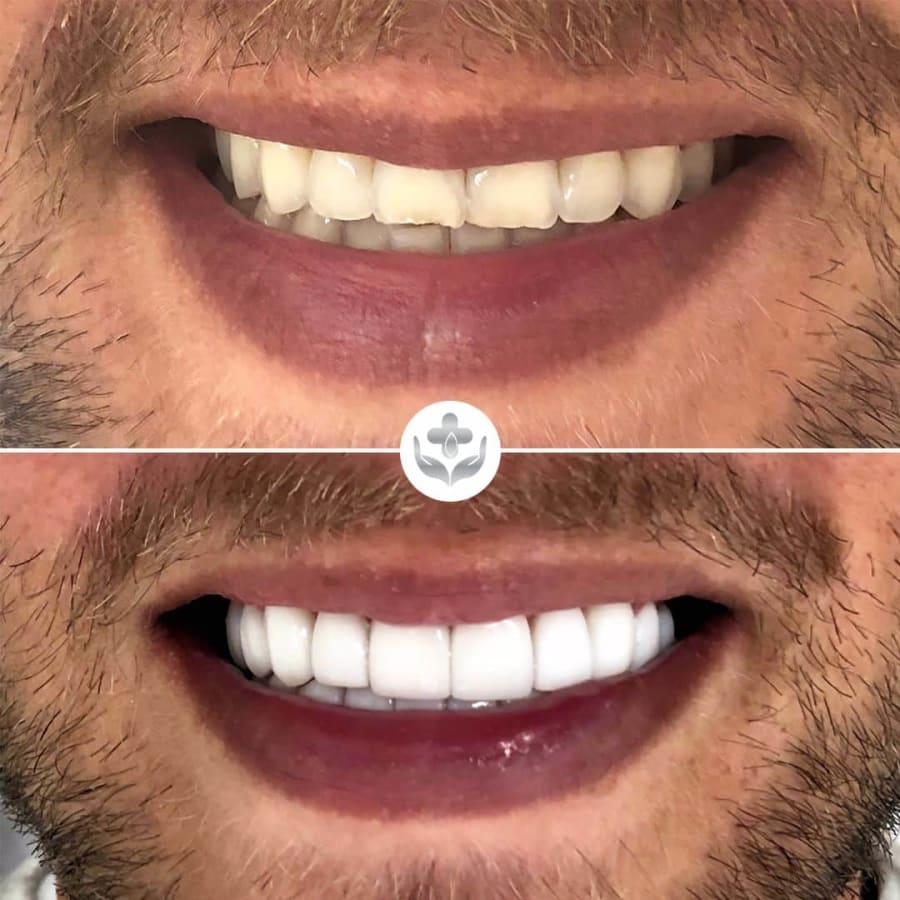
Stand in front of a mirror and give a big, natural smile. Count the upper teeth you can see. For most people, that's 8 to 10 teeth — the two central incisors, the laterals, the canines, and the first premolars (sometimes the second premolars on a wide smile).
Those visible teeth are your "smile zone." Veneers go there. The molars at the back, and most of your lower teeth, usually don't show — so they usually don't get veneers in a cosmetic case.
This is why the most common veneer counts are even numbers centered on the front of the mouth: you're treating the symmetric set of teeth that frame your smile.
Why 8 is the most common number
Eight veneers — covering the upper teeth from canine to canine plus the first premolars — is the workhorse cosmetic case. It gives you:
- A complete, symmetric upper smile
- Coverage of every tooth most people see in photos and conversation
- A natural transition to your own teeth at the corners, where shadow hides the edge
For the majority of patients who want a "new smile," 8 upper veneers is the answer. Many never touch the lower teeth at all, because the lowers show much less.
When you need 10 (or more upper)
You may need 10 if:
- You have a wide smile that shows the second premolars or first molars
- Your second premolars are visibly discoloured or out of line
- You want zero visible transition between veneered and natural teeth
A "10-veneer smile" extends the perfect zone one tooth further back on each side. If your smile is broad, going to 10 prevents the giveaway where bright new veneers meet darker natural teeth mid-smile.
When 6 is enough
Six veneers — the upper canine-to-canine — works when:
- Your smile line is narrower and the premolars barely show
- Your main concern is the front teeth (a gap, a chip, discoloration on the incisors)
- Budget is the deciding factor and you want the biggest visual change for the lowest cost
Six can look fantastic. The risk is the "six-pack smile" — six bright veneers with darker natural teeth on either side. A good cosmetic dentist manages this by matching the veneer shade closer to your natural teeth so the transition is invisible. If you want Hollywood-white, 6 is usually too few.
What about the lower teeth?
Most cosmetic cases are upper-only. But you'll want lower veneers (typically 6–8) if:
- Your lower teeth show noticeably when you talk or smile
- There's a shade mismatch — bright new uppers make natural lowers look yellow by contrast
- You're doing a full smile makeover and want top-and-bottom harmony
A common combination is 8 upper + 6 lower = 14, which is the "full smile makeover" most patients picture when they imagine a complete transformation.
How the number maps to cost (Colombia, 2026)
Because veneers are priced per tooth, the count is the single biggest driver of your total. Approximate porcelain pricing at our Medellín clinic:
| Veneer count | What it covers | Approx. total (porcelain) |
|---|---|---|
| 6 | Upper front (canine to canine) | $2,100 – $3,600 |
| 8 | Full upper smile zone | $2,800 – $4,800 |
| 10 | Wide upper smile | $3,500 – $6,000 |
| 14 (8+6) | Full upper + lower makeover | $4,900 – $8,400 |
For comparison, an 8-veneer porcelain case runs $9,600–$20,000 in the US. The full breakdown across treatments is in our smile makeover cost guide, and material choice (which changes the per-tooth price) is covered in porcelain vs composite.
How we decide your exact number
During the free virtual consult, we ask for a few photos: a big natural smile, a relaxed smile, and a side profile. From those we can see:
- Your smile line — how many teeth show
- Your shade — how white we can go before the transition looks fake
- Your symmetry — whether one side shows more than the other
From there we recommend a specific number and show you the trade-offs. We'll also tell you when fewer is better — there's no upsell to a full set you don't need.
If you want the full process and trip overview, the veneers pillar page walks through materials and timeline, and the package page shows what's included. Spanish-speaking patients can read about carillas dentales and paquetes de carillas in español.
Next step
Send a few smile photos to WhatsApp and we'll reply with a recommended veneer count, the material we'd suggest, and a total cost — within 24 hours, free, no obligation. We'll tell you the honest number, not the biggest one.
More from our blog.

Multiple Dental Implants vs All-on-4: Where the Tipping Point Really Is
Several failing teeth on one arch? How individual implants and All-on-4 compare on cost, healthy teeth, bone, trips and long-term risk, with the real per-arch math at Colombia Care Dental and the cases where each one is the wrong answer.

Veneers vs Invisalign for Crooked or Gapped Teeth: Which Should You Choose?
Veneers can make crooked or gapped teeth look straight in a week. Aligners actually move them. Here's when each is the right call, what each costs, and when the honest answer is to do both, in that order.
Gum Contouring Before Veneers: When You Need It (and When You Don't)
Uneven or 'gummy' gumlines can make even perfect veneers look off. Here's when gum contouring actually helps, what it costs in Colombia, how healing fits a veneers trip, and when it's the wrong fix.