

Do You Need a Bone Graft for Dental Implants? Types, Timeline & Cost

Why bone disappears after an extraction, how the CBCT scan decides it, the four graft types, and what a bone graft costs in Colombia vs the US. Including when you don't need one at all.
"Do I need a bone graft?" is usually the second question an implant patient asks, right after the price. It matters because a graft changes three things at once: the total cost, the number of trips, and how long the whole case takes from start to finished tooth.
The honest answer is that nobody can tell you over WhatsApp — not us, not your dentist at home. It takes a 3D scan. But you can understand the logic well enough to know roughly where you'll land, and that's what this post is for.
Quick answer
An implant needs bone around it on all sides to hold. If the bone that used to surround your missing tooth has shrunk below roughly 1 mm of wall thickness around where the post needs to sit, or there isn't enough height above a nerve or below a sinus, you need a graft to rebuild it first.
In practice: about 30 to 40% of our implant patients need some kind of bone work. The single biggest predictor is how long the tooth has been gone. A tooth extracted last month rarely needs a graft. A tooth gone for ten years usually does.
Cost in Colombia runs $500 per site for a standard graft and $600 for a sinus lift, versus $600 to $3,500 in the US. The bigger cost isn't money, it's time: a graft usually adds 3 to 6 months of healing before the implant can go in.
Why bone disappears after you lose a tooth
Your jawbone isn't a fixed structure. It's living tissue that maintains itself in response to load, and the tooth root is what transmits chewing force into the bone around it. That force is the signal telling the bone to stay.
Take the root out and the signal stops. Bone that existed specifically to hold that tooth has no job anymore, so your body reclaims the mineral. This is resorption, and it's fast at the start:
- First 6 months: roughly 25% of the width of the ridge is gone
- First 12 months: up to 40 to 50% of width, and about 20% of height
- After that: slow, continuous loss for the rest of your life
The width goes before the height, and it goes from the outside face of the jaw (the cheek side), which is the thinnest wall. That's why a long-missing tooth leaves a ridge that looks fine in a photo but is a knife-edge on the scan.
Denture wearers lose more, not less: a denture presses on the ridge without loading it the way a root does, so it accelerates the flattening.
How you actually find out: the CBCT scan
A regular panoramic X-ray is a flat image. It shows height, roughly, and nothing about width. You cannot plan an implant from one, and any clinic quoting a firm implant plan from a pano alone is guessing.
A CBCT (cone beam computed tomography) is a 3D scan of your jaw. It takes about 20 seconds, uses a fraction of the radiation of a medical CT, and produces a volume we can slice in any direction. At the exact spot the implant needs to go, it tells us:
- Bone width — we need enough to leave ~1 to 1.5 mm on each side of the post
- Bone height — how much is left before the sinus floor above or the nerve canal below
- Bone density — soft type IV bone in the upper back jaw behaves differently from dense type I bone in the lower front
The CBCT is included in our implant pricing and we take it on Day 1 of Trip 1. If you already have a recent one, send us the raw DICOM files (not a screenshot of the report) and we can usually tell you before you book a flight.
The four kinds of bone graft
"Bone graft" is one phrase covering four fairly different procedures. Which one you need depends on what's missing and where.
| Graft type | What it does | When it's used | Healing before implant |
|---|---|---|---|
| Socket preservation | Fills the empty socket immediately after extraction to stop resorption before it starts | At the same visit as an extraction, when the implant will come later | 3 to 4 months |
| Ridge augmentation | Rebuilds width (or height) on a ridge that has already shrunk | Tooth gone for years, ridge too thin for a post | 4 to 6 months |
| Sinus lift | Lifts the sinus membrane and packs graft underneath to gain vertical height | Upper back teeth, where the sinus has dropped into the space | 4 to 6 months (lateral); often 0 with the crestal technique |
| Block graft | A solid block of bone screwed onto the ridge, for severe defects | Large defects; trauma; very long-term edentulous ridges | 5 to 6 months |
Two are worth expanding on.
Socket preservation is the cheap one. If a tooth is coming out and an implant is coming later, grafting the socket at the moment of extraction costs a few hundred dollars and largely prevents the collapse. Skipping it and coming back in three years often means a ridge augmentation that costs more, hurts more, and heals slower. If you're reading this before an extraction, that's the most useful sentence on the page.
Sinus lifts come in two flavours. The crestal technique goes up through the implant hole itself, gains 3 to 4 mm, and is done in the same appointment as the implant — no extra healing period. The lateral window technique opens the side of the jaw, gains 8 to 10 mm or more, and needs its own healing time. Which one you need is a matter of millimetres on the scan.
What the graft material actually is
Patients tend to picture bone being harvested from their hip. That's rare now. Four material classes, and most modern cases use the second or third:
| Material | Source | Notes |
|---|---|---|
| Autograft | Your own bone, taken from the chin, jaw angle, or hip | The biological gold standard — it contains living cells. Requires a second surgical site, so it's reserved for block grafts and large defects |
| Allograft | Processed human donor bone from a tissue bank | Sterilised, cell-free mineral scaffold. Your bone grows into it and replaces it. The workhorse for most sockets and ridges |
| Xenograft | Bovine (usually) mineral, e.g. Bio-Oss | Resorbs very slowly, so it holds volume well. Common in sinus lifts |
| Synthetic (alloplast) | Lab-made calcium phosphate / bioglass | No donor material at all. Useful if you have religious or personal objections to donor tissue — tell us and we'll plan around it |
None of these are "the bone." They're a scaffold. The graft holds space and gives your own cells a lattice to crawl along and lay down real bone. That biology takes months and can't be rushed — which is the real reason for the timeline below.
Most grafts are covered with a resorbable collagen membrane to stop gum tissue growing into the space (gum grows much faster than bone).
The timeline, honestly
This is the part that changes your travel planning.
| Scenario | Sequence | Total time to finished tooth |
|---|---|---|
| No graft needed | Implant → 4 to 6 months healing → crown | 5 to 7 months, 2 trips |
| Socket preservation | Extraction + graft → 3 to 4 months → implant → 4 to 6 months → crown | 8 to 11 months, 2 to 3 trips |
| Simultaneous graft | Implant + graft together → 4 to 6 months → crown | 5 to 7 months, 2 trips |
| Staged ridge augmentation | Graft → 4 to 6 months → implant → 4 to 6 months → crown | 9 to 13 months, 3 trips |
| Lateral sinus lift | Sinus lift → 4 to 6 months → implant → 4 to 6 months → crown | 9 to 13 months, 3 trips |
The row that matters most is the third. When the defect is small and the implant still has good primary stability, we graft and place the implant in the same appointment. The graft heals during the osseointegration window you were going to spend anyway, so it costs zero extra months. That's what we aim for on every borderline case.
Cost: Colombia vs the US
| Procedure | Colombia (Colombia Care) | Typical US price |
|---|---|---|
| Socket preservation / standard graft | $500 per site | $600 to $1,200 |
| Sinus lift (crestal) | $600 | $1,500 to $2,500 |
| Sinus lift (lateral window) | $600 | $2,000 to $3,500 |
| Block graft | quoted per case | $3,000 to $6,000 |
| CBCT scan | included | $150 to $400 |
| Tooth extraction | $105 per tooth | $200 to $600 |
Two honest caveats. First, the graft is rarely the deciding factor in the Colombia-vs-home math — a $500 graft is noise next to the $2,800 to $4,800 you save on the implant itself. Nobody should fly here for a bone graft; it's an add-on to a decision you were already making.
Second, the extra trip is a real cost. If your case needs a staged graft, budget another flight and another two to three days — roughly $600 to $1,100 all-in. It still comes out ahead of US pricing, but it belongs in your spreadsheet from the start, not discovered on Day 1.
When you don't need a bone graft
We quote a graft when the scan shows one is needed, and say so when it isn't. Cases that typically need no bone work:
- Fresh or recent extraction sites — the socket walls are still intact
- Lower front and premolar regions — dense bone, generous width, well away from the sinus
- Anyone whose ridge measures ≥ 6 mm wide and ≥ 10 mm tall at the site — that's enough for a standard-diameter implant with a safe margin
- Cases solvable by geometry instead of biology — sometimes a narrow-diameter implant, a slightly angled trajectory, or a short implant reaches good bone without any graft at all. Angulation is exactly how All-on-4 avoids sinus lifts in the upper jaw: the back implants are tilted to catch the dense bone in front of the sinus
That last point cuts against a clinic's financial interest, so it's worth stating plainly: a tilted implant is not a compromise, and for full-arch cases it routinely replaces a bilateral sinus lift that would have added six months and thousands of dollars. If someone quotes you two sinus lifts for a full upper arch without discussing tilted implants, get a second opinion.
When you're not a candidate — for now
Grafts fail more often in some people, and it is not kind to take their money and find out later. We will ask you to fix these first, or decline the case:
- Active smoking. The big one. Smoking constricts the microvasculature that has to invade the graft, and failure rates run roughly 2 to 3× higher. We ask for a genuine pause — not cutting down — across the healing window. Vaping is not a workaround.
- Uncontrolled diabetes. HbA1c above ~8% meaningfully impairs bone healing. Below 7% you heal essentially like anyone else. Fixable, and worth fixing first.
- Active gum disease. Grafting into an infected field doesn't work. Periodontal treatment comes first, always.
- IV bisphosphonates or denosumab. These carry a real risk of osteonecrosis of the jaw. Oral bisphosphonates for routine osteoporosis are a much smaller concern, but tell us the drug and the duration either way.
- Head or neck radiation to the jaw. Possible in some cases, but not a dental-tourism case. Stay with a hospital team at home.
- Unrealistic timeline. If you have one week and your scan says staged ridge augmentation, your case doesn't fit your calendar. We'll say so rather than start something we can't finish.
Risks and what failure looks like
Bone grafting is routine and well-established, but it isn't free of risk. Success rates for socket preservation and standard ridge augmentation run above 90%; lateral sinus lifts run 90 to 95% in experienced hands. What can go wrong:
- The graft doesn't take. Usually infection, membrane exposure, or smoking. You lose the healing time, and a failed graft is assessed case by case to decide whether and how to regraft. Our written warranty covers veneers, crowns and bridges (2 years), not grafts. If an implant itself fails, replacement costs $250 instead of the full $1,200, surgery included.
- Membrane exposure. The collagen membrane peeks through the gum during healing. Often manageable, but it reduces the volume you end up with.
- Sinus membrane perforation during a lift — maybe 10 to 20% of lateral cases. Usually patched in the same appointment and the case proceeds normally.
- Under-gain. The graft takes but yields less width than planned. Sometimes a narrower implant still works; sometimes it means a second graft.
Post-op reality: swelling peaks at 48 to 72 hours, bruising is normal, and most patients need ibuprofen rather than anything stronger. Sinus lifts add rules — no nose blowing, no straws, no flying for a few days. That last one matters for your return flight, and we plan around it.
Next step
If you have a CBCT or a panoramic X-ray from a dentist at home, send it to us on WhatsApp and we'll tell you within 24 hours whether bone work is likely, which type, and what it does to your timeline and total. Raw DICOM files are ideal; a photo of the film still helps.
No X-rays? Tell us which teeth are missing and roughly how long they've been gone. That alone gets us most of the way to an honest estimate — and if the answer is "we can't know until we scan you," we'll say that too.
More on the procedure on our dental implants page, or read the full 2026 implant pricing breakdown. En español: implantes dentales. To email or book a call instead, everything's on our contact page.
Send your scan, get a straight answer in 24 hours
We'll tell you whether your case needs a graft, which type, how many trips it adds, and the total — before you book anything.
Get a Free AssessmentMore from our blog.
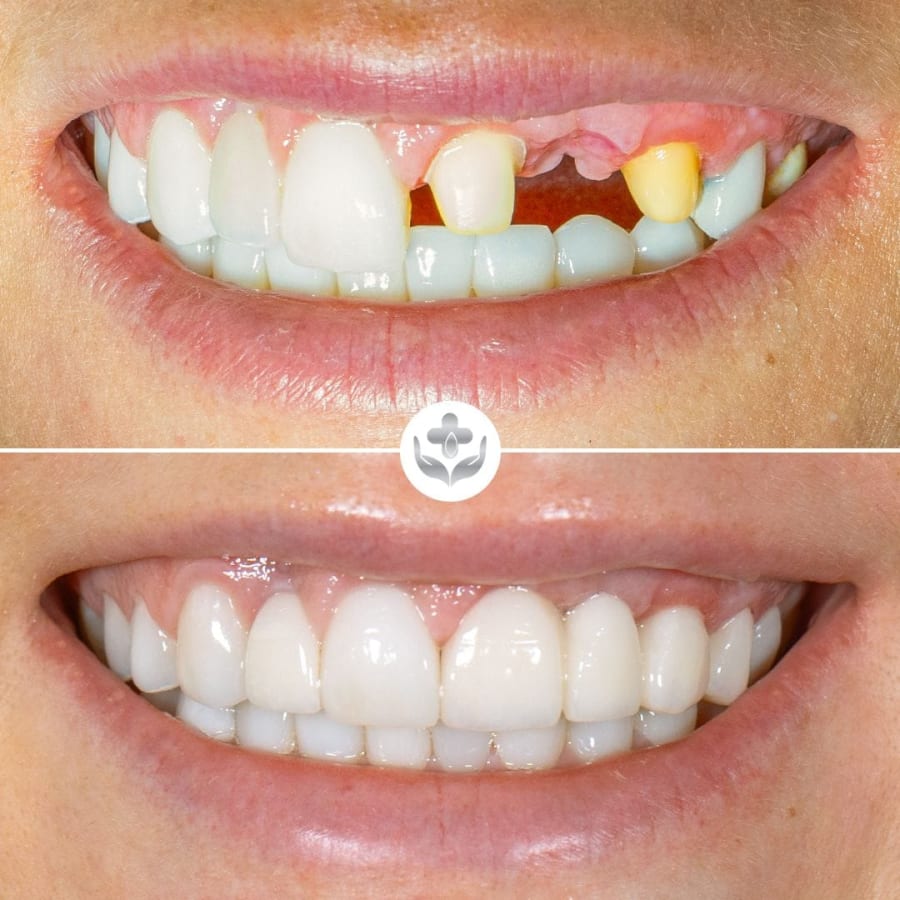
Full-Mouth Reconstruction: What It Involves, Who Needs It & How It's Sequenced
Full-mouth reconstruction rebuilds the bite as well as the smile: crowns, implants, root canals and veneers planned together. What it involves, who actually needs it, the order the work is done in, what it costs in Colombia, and when a full-arch bridge is the better answer.

Veneer Chipped or Fell Off After You Flew Home? What to Do First
A veneer that pops off or chips after a dental trip abroad is rarely an emergency. What to do in the first 24 hours, whether a local dentist can re-bond it, what the warranty covers, and how to stop it happening again.

Zirconia vs E.max Crowns: Strength, Looks, Cost & Which Teeth Need Which
Zirconia (ZirCAD Prime) is the stronger crown, e.max (lithium disilicate) is the more lifelike one. How they compare on strength, looks, tooth preparation and price, which teeth usually get which, and when neither is the right answer.