

Dental Implant vs Bridge: Which Is Right for a Single Missing Tooth?

How a single implant and a three-unit bridge really compare: what happens to the neighbouring teeth and the bone underneath, how long each lasts, the true cost over 20 years, and the specific cases where a bridge is still the better answer.
Losing a single tooth puts you in front of a decision that most people make quickly and many regret slowly. A bridge is faster, cheaper up front, and involves no surgery. An implant costs more, takes months, and involves a titanium post in your jaw. Put that way, the bridge sounds like the sensible choice.
It often isn't — and the reasons have less to do with the missing tooth than with the two healthy teeth on either side of it. Here is how the two options actually compare, where the bridge genuinely wins, and how to decide for your own mouth rather than for the average one.
Quick answer
- An implant replaces the tooth root and crown independently. It leaves the neighbouring teeth untouched and keeps the jawbone stimulated.
- A bridge replaces the crown only, and anchors it by crowning the two adjacent teeth. Those teeth must be ground down to do it.
- Implants last longer — typically 20 years or more with a success rate above 95% — and are easier to clean. Bridges usually need replacing every 10 to 15 years.
- Over 20 years an implant is usually the cheaper option, even where the up-front cost is higher.
- A bridge is still the right call when the neighbouring teeth already need crowns, when surgery is medically off the table, or when you need the gap closed in weeks, not months.
What each option actually is
A dental implant is a titanium post placed in the jawbone where the root used to be. Over three to six months the bone bonds to it — a process called osseointegration — after which an abutment and a ceramic crown are fitted on top. Structurally it is a new, independent tooth with its own root. We use BioHorizons implants at the clinic; our post on why we chose BioHorizons explains the reasoning.
A conventional bridge is three crowns fused together. The two outer crowns fit over the teeth either side of the gap; the middle one — the pontic — sits in the space where the tooth was. To fit those outer crowns, a dentist removes roughly 1 to 2 millimetres of enamel and dentine all the way around each anchor tooth. That is the part patients rarely hear clearly: a bridge for one missing tooth means permanently reshaping two teeth that had nothing wrong with them.
A resin-bonded (Maryland) bridge is the conservative cousin: a single false tooth held by thin metal or ceramic wings glued to the backs of the neighbours, with little or no drilling. It suits front teeth in low-bite-force positions and is a reasonable interim solution, but wings de-bond over time and it is not a long-term answer for molars.
The neighbouring teeth: the real cost of a bridge
Enamel does not grow back. Once the two anchor teeth are prepared for crowns, they are crowned teeth for life. That has three consequences that tend to surface a decade later:
- Sensitivity and nerve risk. Preparing a healthy tooth removes its protective outer layers. A proportion of crowned teeth eventually need root canal treatment because the pulp inside becomes inflamed — the published figures vary, but it is not rare.
- Decay at the margins. A bridge is one connected unit, so it cannot be flossed normally. Plaque collects where the crowns meet the gum, and decay there is hidden under ceramic until it is advanced. When one anchor fails, the whole bridge fails with it.
- The domino effect. If an anchor tooth is later lost, you no longer have a one-tooth gap; you have a two- or three-tooth gap, and the next bridge needs to span further or you are now looking at implants anyway — but with fewer natural teeth to work with.
An implant sidesteps all three. The neighbours are not drilled, not crowned, and flossed exactly as before.
The bone underneath
This is the argument dentists find most persuasive and patients hear least often.
Tooth roots stimulate the jawbone every time you bite. Remove the root and the bone in that spot begins to resorb — noticeably within the first year, then steadily afterwards. Under a bridge pontic, that shrinkage continues indefinitely, which is why older bridges develop a visible gap between the false tooth and the gum, and why the gum line around them tends to look sunken.
An implant is the only replacement that stimulates bone the way a root does. It does not just fill the gap; it preserves the ridge around it. That matters for appearance in the front of the mouth and for keeping options open at the back. It is also why we advise not to wait years before replacing a lost tooth: the longer the gap sits empty, the more likely you will need bone grafting before an implant is possible.
Longevity, maintenance, and what goes wrong
| Single implant | Three-unit bridge | |
|---|---|---|
| Typical lifespan | 20+ years; often life | 10 to 15 years |
| Reported success | Above 95% at 10 years | Around 85 to 90% at 10 years |
| Affects neighbouring teeth | No | Yes — both permanently crowned |
| Preserves jawbone | Yes | No — bone resorbs under the pontic |
| Cleaning | Brush and floss like a natural tooth | Floss threaders or a water flosser under the pontic |
| Common failure | Peri-implantitis (gum infection) if hygiene lapses; rare mechanical failure | Decay at the anchor margins; anchor tooth fracture; de-cementing |
| Repairable? | Crown can be replaced without touching the post | Usually the entire bridge is remade |
| Surgery required | Yes — minor, under local anaesthetic | No |
| Time to finished tooth | 3 to 6 months (longer with grafting) | 1 to 3 weeks |
The lifespan gap is the headline. A bridge fitted at 40 is likely to be replaced at 52 and again in the mid-sixties, and each replacement is more involved than the last because the anchor teeth have less structure left. An implant fitted at 40 has a good chance of still being there at 70, with perhaps a new crown along the way.
Time and healing
A bridge wins here outright. Two appointments, a week or two apart, and you leave with a fixed tooth. There is no surgery and no waiting for bone.
An implant is a longer road: placement, a healing period of three to six months while the bone integrates, then the crown. If bone grafting is needed, add several months. Our implant healing timeline walks through it stage by stage. For an international patient this generally means two trips to Medellín — one for placement, one for the crown — versus one trip for a bridge. We can often fit a temporary tooth for the front of the mouth so you are never walking around with a visible gap.
If the missing tooth is front and centre and you have a wedding in six weeks, a bridge — or a Maryland bridge as a stopgap — may be the pragmatic answer. If you can plan for the longer timeline, the implant usually pays that patience back.
The cost over 20 years
Up-front pricing is where bridges look attractive, and it is also where the comparison is most misleading. The honest way to compare is over the life of the restoration.
| Single implant | Three-unit bridge | |
|---|---|---|
| US clinic, up-front | $4,000 to $6,000 all-in | $2,000 to $5,000 depending on material |
| Colombia Care, up-front | $1,200 all-in (post, abutment, crown) | Quoted case by case; typically well under US pricing |
| Expected replacements in 20 years | 0 (possibly one new crown) | 1 to 2 full remakes |
| Risk of added treatment | Low, with good hygiene | Root canals or extractions on anchor teeth are common by year 15 |
| Realistic 20-year cost, US | $4,000 to $7,000 | $5,000 to $12,000 or more |
Three things drive the long-term gap: the bridge gets remade, the anchor teeth generate their own treatment, and an anchor failure can turn a one-tooth problem into a multi-tooth one. Our full breakdown of what implants cost here — including travel and what the $1,200 figure does and does not include — is in the implant cost guide. If you are weighing dental travel and want to know what your home insurance may reimburse, we cover that in insurance reimbursement for dental tourism.
When a bridge is still the better answer
We place far more implants than bridges, but a bridge is the right call more often than implant marketing admits:
- The neighbouring teeth already need crowns. Large old fillings, cracks, or existing crowns on both sides mean you lose nothing by crowning them — and a bridge treats three problems in one restoration.
- Surgery is not an option. Uncontrolled diabetes, certain bisphosphonate or radiotherapy histories, heavy smoking you are not willing to stop, or a bleeding disorder can all make implant surgery unwise. A bridge needs none of it.
- There is not enough bone and you do not want grafting. Grafting is routine, but it adds time, cost, and a second healing period. Some patients reasonably decline.
- Speed matters more than longevity. A visible front-tooth gap with a fixed deadline.
- The budget is fixed and short-term. A bridge is cheaper this year even if it is dearer over twenty. That is a legitimate trade-off if it is made knowingly.
- You are under 18. Implants are placed only once jaw growth is complete; a bonded bridge holds the space until then.
When an implant is clearly the better answer
- The teeth either side of the gap are healthy and unrestored. Grinding them down for a bridge is the worst trade in dentistry.
- You are under 60 with decades of use ahead. The longevity gap compounds.
- The gap is a back molar, where bite forces are highest and bridges fail fastest.
- You have adequate bone, or are willing to graft.
- You want a tooth you can floss normally and forget about.
What we do at the clinic
For a single missing tooth, our default recommendation is an implant when the neighbours are healthy and the bone allows — because it is the option that protects the rest of your mouth. We say so plainly, and we also say plainly when a bridge is the smarter call for your specific case. The assessment is straightforward:
- Send a photo and, if you have one, a recent X-ray or panoramic scan. We give you a preliminary read on bone, the state of the neighbouring teeth, and which option we would lean towards.
- On arrival, a 3D cone-beam CT. This tells us exactly how much bone there is and whether a graft is needed.
- A single written plan with both options priced, so you can compare honestly rather than being steered.
Full details of the implant process, warranty, and what the $1,200 all-in price covers are on our implants page. Para pacientes hispanohablantes, tenemos la misma información sobre implantes dentales.
The bottom line
A bridge fixes the gap. An implant fixes the gap without spending two healthy teeth and a slice of your jawbone to do it. For most people with a single missing tooth and healthy neighbours, the implant is the better long-term decision — and over twenty years it is usually the cheaper one too. The bridge earns its place when the neighbours are already compromised, when surgery is off the table, or when time is the constraint that matters.
Whichever you choose, choose it knowing what happens to the teeth next door.
Next step
Send us a photo of the gap — and an X-ray if you have one — on WhatsApp and we'll tell you honestly which option we'd recommend for your case, whether you'd need a graft, and what each would cost. Free, no obligation — or reach us through our contact page.
More from our blog.
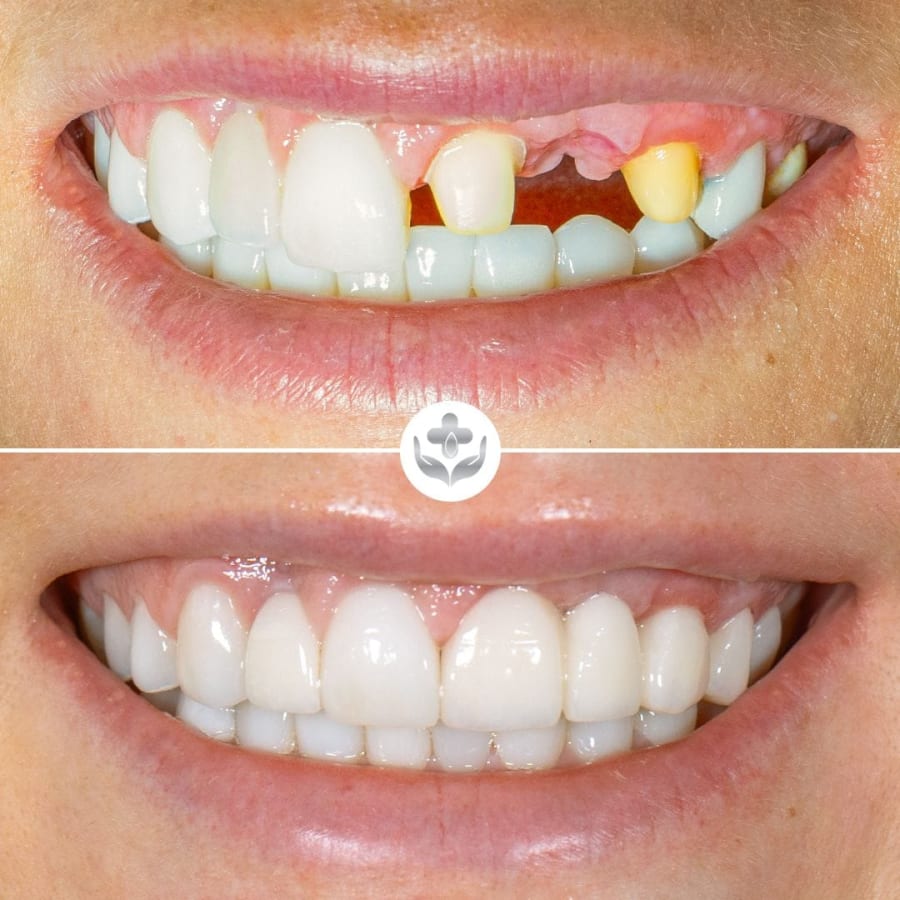
Full-Mouth Reconstruction: What It Involves, Who Needs It & How It's Sequenced
Full-mouth reconstruction rebuilds the bite as well as the smile: crowns, implants, root canals and veneers planned together. What it involves, who actually needs it, the order the work is done in, what it costs in Colombia, and when a full-arch bridge is the better answer.

Veneer Chipped or Fell Off After You Flew Home? What to Do First
A veneer that pops off or chips after a dental trip abroad is rarely an emergency. What to do in the first 24 hours, whether a local dentist can re-bond it, what the warranty covers, and how to stop it happening again.

Zirconia vs E.max Crowns: Strength, Looks, Cost & Which Teeth Need Which
Zirconia (ZirCAD Prime) is the stronger crown, e.max (lithium disilicate) is the more lifelike one. How they compare on strength, looks, tooth preparation and price, which teeth usually get which, and when neither is the right answer.