

What to Expect After Getting Veneers: The First Two Weeks & Beyond

What is normal after veneers are bonded: sensitivity, a bite that feels different, a slight lisp, gum tenderness. A day-by-day guide to the first two weeks, what to eat, when to worry, and the care that makes them last.
Most people spend weeks researching veneers before they book: materials, shades, prices, clinics. Very few spend five minutes on what the days after bonding feel like. That gap is why the most common message we get from patients on their first evening is some version of "Is this normal?"
Usually, it is. New veneers change the shape, thickness and feel of your front teeth overnight, and your mouth needs a little time to catch up. This guide covers what to expect in the first 48 hours, the first two weeks, and the long run, what you can eat, which sensations are normal, and the few signs that mean you should get in touch.
If you are still at the deciding stage, start with our veneers in Medellín guide, which covers materials, prices and the treatment process.
Quick answer
- Mild cold sensitivity for a few days is normal, especially on porcelain and zirconia veneers where a thin layer of enamel was prepared. It usually fades within one to two weeks.
- Your bite and your tongue will notice the new shape. Teeth can feel "big" or slightly forward at first. Most people stop noticing within a week or two.
- A slight lisp on "s" and "f" sounds is common for the first few days and almost always resolves on its own as your tongue adapts.
- Gums may be a little tender where the veneer edges meet them. Warm salt-water rinses help.
- Eat soft food for the first day or two, avoid biting hard things with your front teeth, and skip coffee, red wine and dark tea for 48 hours while the bonded margins settle.
- Pain that gets worse, a bite that feels "high" after a few days, or swelling are not normal. Message us with photos.
The first 48 hours
On bonding day you walk out with your final veneers, not a preview. The appointment usually runs three to four hours: try-in, any final tweaks to shade or edge shape, bonding with resin cement, a bite check, and polishing. If your teeth were prepared under local anaesthetic, the numbness wears off within one to two hours.
What most patients notice that evening:
- Smoothness and bulk. Your tongue will keep exploring the new surfaces. Veneers are thin (often 0.3 to 0.7 mm), but even that registers as "different" to a tongue that has known the same teeth for decades.
- A bright, uniform colour that can look whiter in the bathroom mirror than it did in the clinic's daylight. Give it a day before you judge the shade; mirror lighting and the contrast with lips that are still slightly numb or dry both exaggerate it.
- Some cold sensitivity, especially when you breathe in through your mouth or drink something chilled.
- A little gum tenderness around the edges, from the bonding process and retraction during cementation.
What to do:
- Eat soft foods: eggs, rice, pasta, soup that has cooled down, fish, ripe fruit, yoghurt.
- Avoid very hot and very cold drinks for the first day if you are sensitive.
- Skip coffee, red wine, dark tea, cola and curry for 48 hours. The veneers themselves resist staining well, but the thin line of cement at the edges is most vulnerable while it finishes setting.
- Brush gently that night with a soft brush, and floss carefully, pulling the floss out sideways rather than snapping it up through the contact.
- Don't drink alcohol heavily on bonding day. You will be tired, and you want to notice how your bite feels.
On our usual itinerary for international patients, we see you again the next day for a short check: a final polish, photos, a bite review, and your aftercare kit. That visit is where we catch most small adjustments before you fly.
Week one and two: what is normal and what is not
This is the period most "is this normal?" questions come from. Here is how we sort them.
| What you notice | Normal? | Typical timeline | What to do |
|---|---|---|---|
| Sensitivity to cold air or drinks | Yes | Fades over 1 to 2 weeks | Sensitivity toothpaste; avoid ice-cold drinks for now |
| Teeth feel big, thick or "forward" | Yes | Most people adapt within 1 to 2 weeks | Nothing; your tongue and lips will adjust |
| Slight lisp on "s", "f" or "th" | Yes | Usually days, rarely more than 2 weeks | Read aloud or talk normally; it speeds adaptation |
| Tender or slightly puffy gums at the edges | Yes, if mild | A few days to a week | Warm salt-water rinses, gentle brushing and flossing |
| A small rough spot or excess cement your tongue finds | Common | Doesn't resolve on its own | Send a photo; it's a quick polish |
| Bite feels "high" on one tooth, or you hit one tooth first | No, if it lasts | Should be fixed, not waited out | Message us; a high spot is adjusted in minutes |
| Sharp pain on biting, or throbbing pain | No | Message us the same day | |
| Sensitivity getting worse instead of better after a week | No | Message us; it needs a look | |
| Swelling of the gum, face or jaw | No | See a dentist promptly, then let us know | |
| A veneer feels loose or clicks | No | Stop biting on it and message us |
Two of these deserve more explanation.
The "high" bite
After bonding, we check your bite with articulating paper and smooth any spot that takes too much load. But your jaw muscles are tired and partly numb on bonding day, so a high spot can feel normal at the clinic and obvious two days later. Don't try to "chew it in." A veneer that takes more than its share of force is the single most common reason one chips or comes off early. It is a five-minute adjustment, and the reason we schedule the next-day check before you fly home.
The lisp
Speech is controlled by tiny tongue movements against the backs of your front teeth. When the length or thickness of those teeth changes, your tongue needs to recalibrate. Talking, reading aloud and singing all help. If a lisp has not improved at all after two weeks, the edge length or thickness may need a look, so send us a short video of you counting from 60 to 70.
Eating with veneers
You do not need a special diet for life. Well-bonded porcelain and zirconia veneers handle normal food. What they don't handle well is concentrated force on the biting edge, which is the same thing that chips natural front teeth.
| Situation | First 48 hours | After the first two weeks |
|---|---|---|
| Soft foods (pasta, eggs, fish, rice) | Yes | Yes |
| Coffee, red wine, tea, cola | Avoid | Fine; rinse with water after |
| Steak and chewy meats | Cut small, chew on the back teeth | Fine; still cut rather than tear |
| Whole apples, corn on the cob, crusty bread | Avoid | Cut into pieces; don't bite straight in with front teeth |
| Ice, hard candy, nuts in the shell, popcorn kernels | Avoid | Avoid for good; these break natural teeth too |
| Sticky candy and caramel | Avoid | Occasional is fine |
| Opening packets, biting tape or nails | Never | Never |
Composite veneers are a little different. Resin picks up stain more readily than porcelain over the years, so coffee and red wine drinkers who chose composite should expect to need a professional polish more often.
Long-term care: the habits that decide how long they last
Porcelain and zirconia veneers can last 15 to 20+ years with good care, and composite 5 to 8. Whether yours reach the top of those ranges depends less on luck than on a handful of habits. Our veneer lifespan guide covers the numbers in detail; this is the short routine.
- Brush twice a day with a soft brush and a non-abrasive toothpaste. Whitening and "charcoal" pastes are abrasive and can dull the surface glaze over time.
- Floss or use interdental brushes daily. Veneers don't decay, but the natural tooth at the edges can, and gum health around the margins is what keeps them looking natural.
- Keep your six-monthly cleanings at home. Tell your hygienist you have veneers and ask for a non-abrasive polishing paste. Your local dentist can do all routine care; you don't need to come back to Medellín for check-ups.
- Wear the night guard if we made you one. If we see signs of grinding or clenching at your consultation, we make a custom guard before you fly home. Grinding without it is the leading cause of chipped and debonded veneers, and it is excluded from the warranty for that reason.
- Use a sports mouthguard for contact sports.
- Don't whiten expecting the veneers to change. Ceramic and resin don't respond to whitening gel. If you want brighter natural teeth next to your veneers, that is best done before the shade is chosen.
What the warranty covers
Our porcelain and zirconia veneers come with a 2-year written warranty covering material defects and bonding failures. If a veneer fails for one of those reasons, we redo it at no cost at our clinic in Medellín. Travel, flights and hotels are never included, which is why a simple re-bond done by your local dentist is often the practical answer for a single veneer.
The warranty does not cover accidents or impact, grinding without a prescribed night guard, or decay and gum problems from skipped cleanings. If something does happen after you're home, our guide to what to do if a veneer chips or comes off walks through the first 24 hours.
When this guide is not for you
Some situations need a different conversation rather than general aftercare advice:
- You had crowns, a bridge or implants rather than veneers. Recovery and care differ, particularly for implants, where healing runs for months. Ask us for the instructions specific to your treatment.
- You have persistent pain, swelling or a bite that feels wrong after a week. That is not an adaptation period; it needs to be examined.
- You grind heavily and were not given a night guard. Ask for one before you rely on the veneers long term.
- You are unhappy with the shade or shape after the first few days. Shade and shape are agreed at the try-in, before bonding, for exactly this reason. But if something genuinely looks wrong once the swelling and novelty settle, tell us early, with photos in daylight.
How long until they feel like your own teeth?
For most people, two to three weeks. The sensitivity fades, the lisp disappears, and the moment your tongue stops checking the new edges is usually the moment you stop thinking about them. After that, veneers ask for the same things natural teeth do: brushing, flossing, cleanings, and not using them as tools.
If you are weighing a full set, our veneers package page lists what is included: 20 porcelain veneers for $5,790, 20 zirconia for $6,990 or 20 composite for $2,390, with a cleaning included in every smile makeover. Individual veneers are $275 (porcelain), $325 (zirconia) and $119 (composite) per tooth.
Para pacientes hispanohablantes: más información sobre carillas dentales en Medellín, incluidos materiales, precios y cuidados después del tratamiento.
Not sure if what you're feeling is normal?
Send us a photo or a short description on WhatsApp: what you notice, which teeth, and when your veneers were placed. We will tell you whether it is part of normal adaptation or something worth a quick adjustment. And if you are still planning your treatment, we can send you a free smile plan from your photos.
Ask Us on WhatsAppMore from our blog.
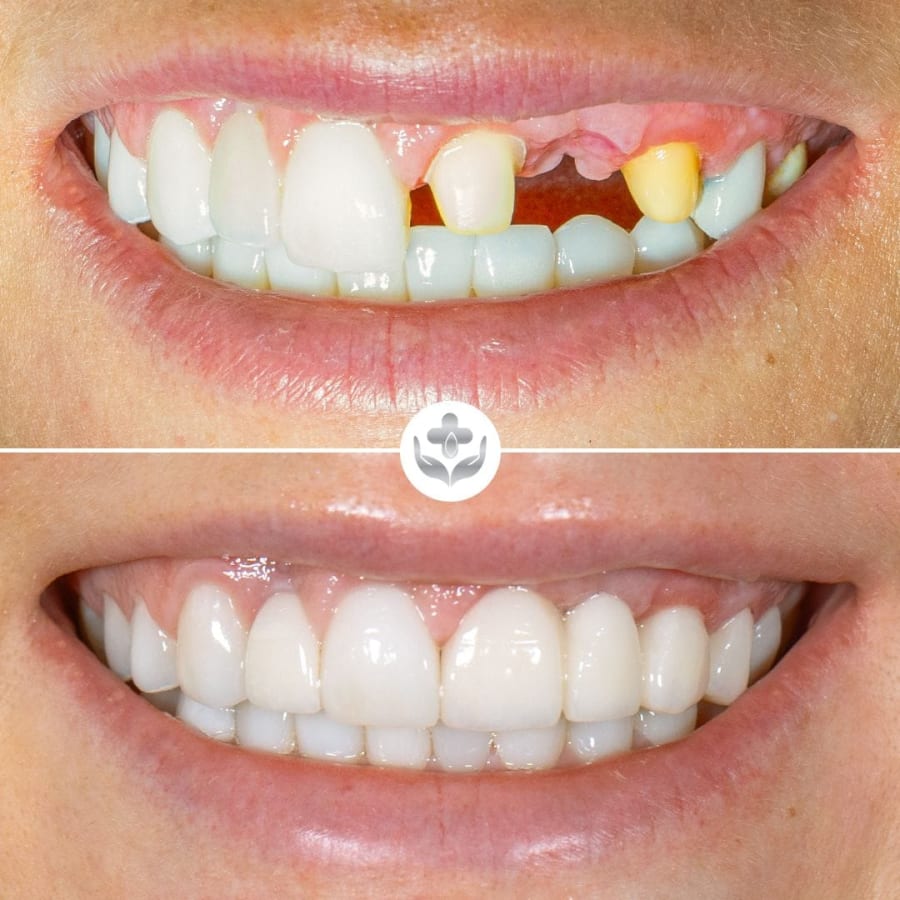
Full-Mouth Reconstruction: What It Involves, Who Needs It & How It's Sequenced
Full-mouth reconstruction rebuilds the bite as well as the smile: crowns, implants, root canals and veneers planned together. What it involves, who actually needs it, the order the work is done in, what it costs in Colombia, and when a full-arch bridge is the better answer.

Veneer Chipped or Fell Off After You Flew Home? What to Do First
A veneer that pops off or chips after a dental trip abroad is rarely an emergency. What to do in the first 24 hours, whether a local dentist can re-bond it, what the warranty covers, and how to stop it happening again.

Zirconia vs E.max Crowns: Strength, Looks, Cost & Which Teeth Need Which
Zirconia (ZirCAD Prime) is the stronger crown, e.max (lithium disilicate) is the more lifelike one. How they compare on strength, looks, tooth preparation and price, which teeth usually get which, and when neither is the right answer.